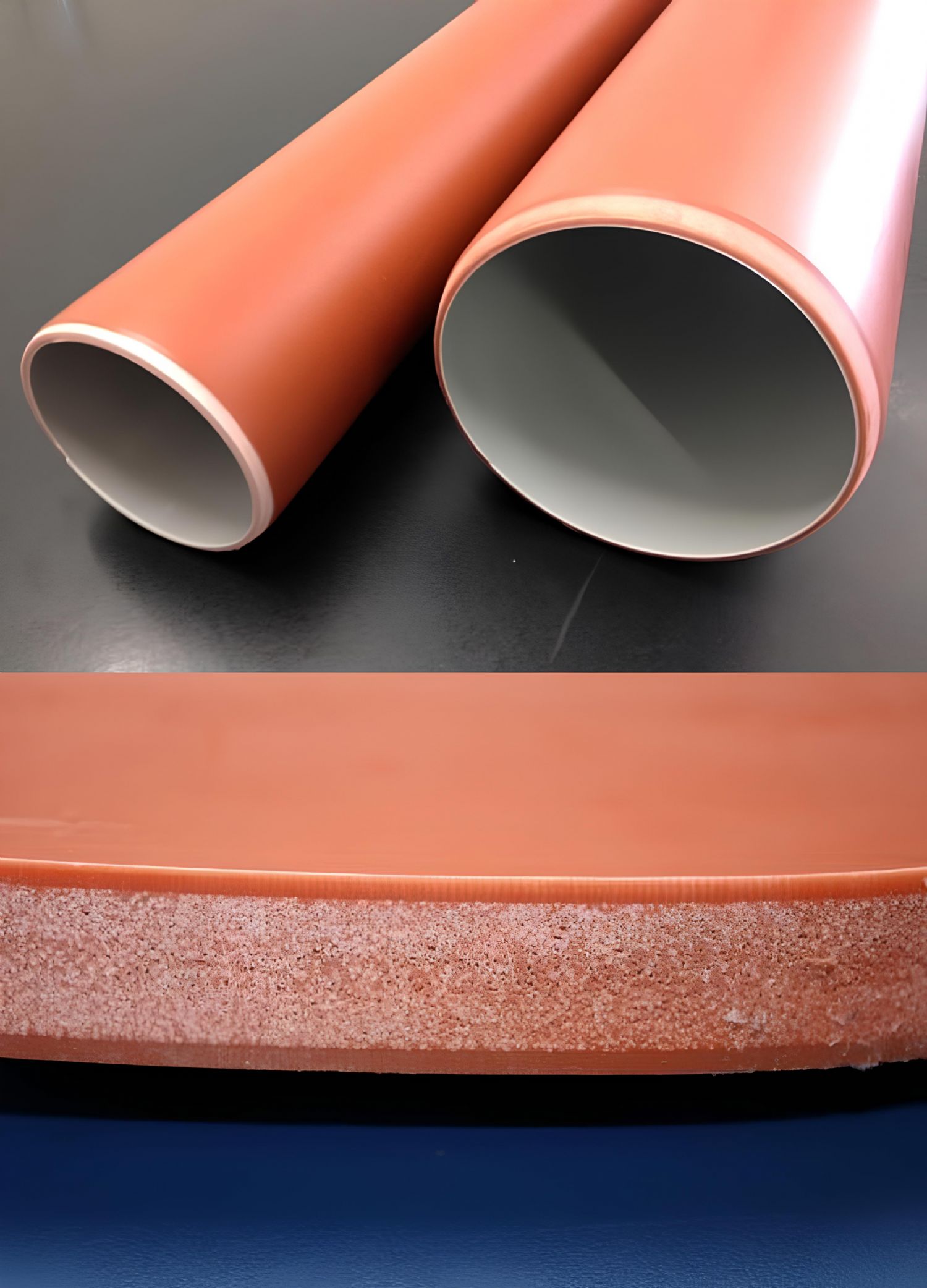
Physical Foaming PP Foamcore Pipes
Foaming of PP foamcore pipes involves incorporating a physical blowing agent into polypropylene material during production. This process creates a lightweight, multilayer structure with enhanced properties suitable for various applications.
Process Overview
Material selection focuses on polypropylene as the primary material due to its versatility, durability, and recyclability. Additives may be included to improve specific properties.
A physical blowing agent such as carbon dioxide or nitrogen is introduced into the molten polymer during extrusion. This agent expands under reduced pressure, forming a cellular foam structure.
The extrusion process produces a three-layer pipe with a solid inner layer, a foamed middle layer, and a solid outer layer for added strength and protection.
Cooling and shaping stabilize the foamcore structure and ensure the desired pipe dimensions.
Quality control verifies uniform foam distribution, dimensional accuracy, and mechanical performance.
Benefits
Weight reduction makes transportation and installation easier and more cost-effective.
Thermal insulation improves energy efficiency, especially in temperature-sensitive applications.
Reduced material usage lowers production costs without compromising quality.
The multilayer structure enhances durability and impact resistance.
Environmentally friendly design reduces material consumption and increases sustainability.
Applications
Drainage systems for residential, commercial, and industrial use.
Irrigation systems in agriculture due to their lightweight and thermal properties.
Sewer and stormwater infrastructure projects.
HVAC systems where insulation is critical.
Advancements
Innovations in physical foaming technology include environmentally friendly blowing agents and advanced extrusion systems.
These developments improve foam uniformity, mechanical properties, and sustainability.
PP foamcore pipes are increasingly favored for their cost efficiency, performance, and eco-friendliness.