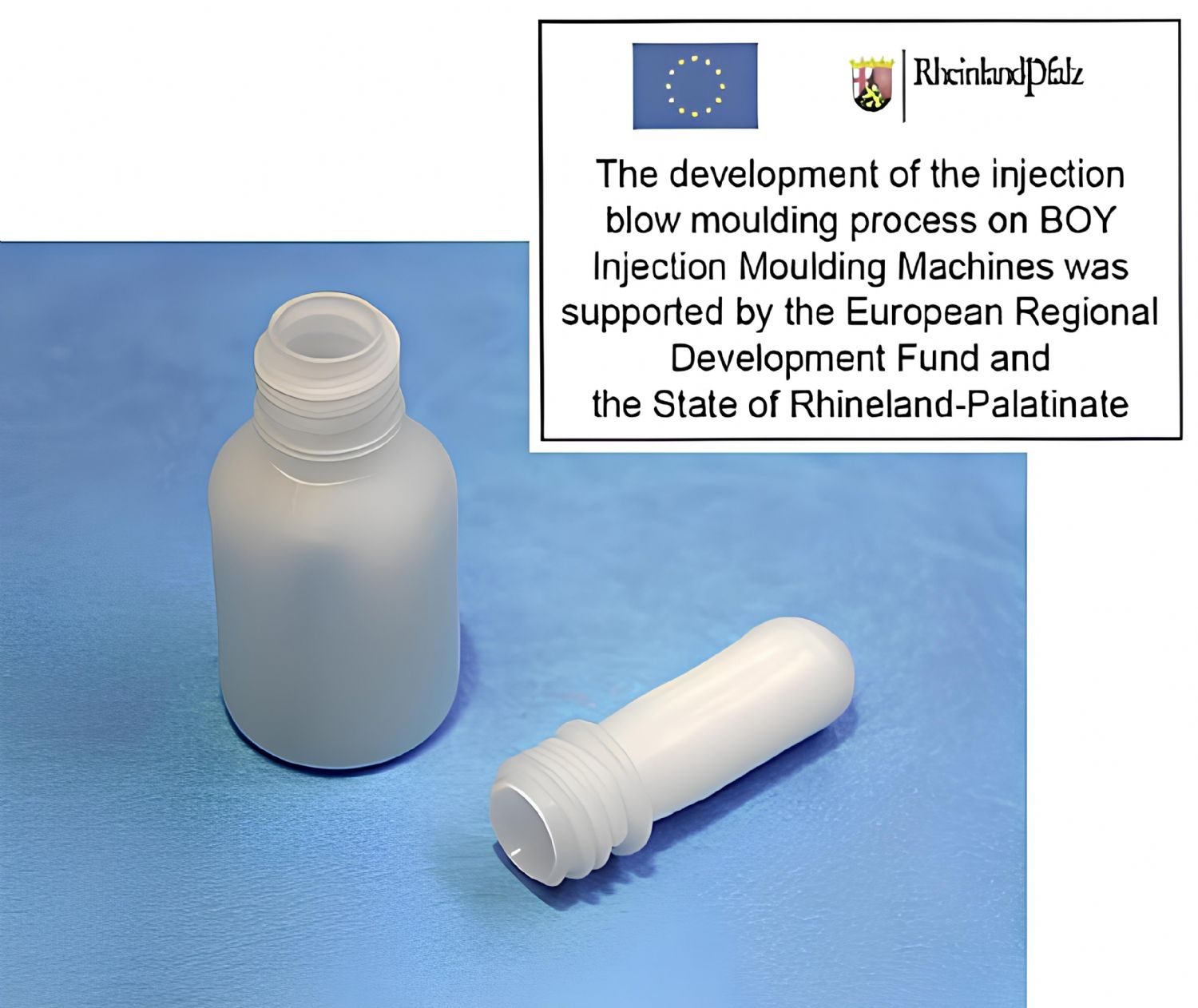
Injection Blow Molding (IBM) Process with Dr. BOY Injection Molding Machines
Injection Blow Molding (IBM) is a specialized manufacturing technology designed for the production of small- to medium-volume hollow plastic products with high precision, excellent dimensional repeatability, and superior surface quality. The process is widely used in pharmaceutical, cosmetic, medical, and laboratory packaging applications, where tight tolerances, uniform wall thickness, and minimal scrap rates are critical. Injection molding machines from Dr. BOY meet these demanding requirements through a compact, stable, and energy-efficient machine architecture.
What Is Injection Blow Molding (IBM)?
Injection Blow Molding is a process that combines injection molding and blow molding into a single, integrated cycle. It consists of three main stages: preform injection, blowing and cooling, and part removal.
In the first stage, molten thermoplastic material is injected into a mold around a core rod to form a hollow, precisely defined preform. In the second stage, the preform is transferred-without significant heat loss-into a blow mold, where compressed air expands it to its final shape. In the final stage, the molded part is cooled and removed from the mold.
A key advantage of the IBM process is that the neck finish of the container is formed entirely by injection molding, resulting in highly accurate and repeatable dimensions that are essential for pharmaceutical and medical packaging.
Preform Injection on Dr. BOY Machines
Preform injection is the most critical phase of the IBM process. Any defects created at this stage cannot be corrected during blowing. Dr. BOY injection molding machines provide extremely stable injection movements, even at low injection speeds, ensuring precise and consistent preform geometry.
Servo-controlled hydraulic systems allow injection speed, pressure profiles, and dosing parameters to be controlled with high accuracy. This results in uniform preform wall thickness and ensures balanced material distribution during the subsequent blowing stage.
Blowing Stage and Wall Thickness Control
During the blowing stage, the preform is expanded against the inner surface of the blow mold using compressed air. The stable clamping system and vibration-free operation of Dr. BOY machines ensure precise alignment of the mold halves during this process.
This stability is essential for achieving homogeneous wall thickness distribution and preventing ovality or localized thinning. These characteristics are particularly important in pharmaceutical and medical containers, where consistent mechanical performance and dimensional accuracy are mandatory.
Cooling and Cycle Time Optimization
In the IBM process, cooling time has a direct impact on both part quality and productivity. The stable clamping force and balanced mechanical movements of Dr. BOY injection molding machines promote uniform heat transfer between the mold surfaces and the molded part.
As a result, cooling times can be optimized, overall cycle times reduced, and production efficiency increased. Shorter cycle times contribute directly to lower cost per part and higher output rates.
Compact Design and Production Cells
The cantilever (tie-bar-less) clamping design of Dr. BOY injection molding machines provides easy access to IBM molds and blowing units. This ergonomic layout shortens mold changeover times and supports the design of compact and efficient production cells.
Thanks to their small footprint, Dr. BOY machines can be easily installed in facilities with limited floor space, making them well suited for dedicated IBM production lines.
Process Repeatability and Quality Assurance
In injection blow molding, product quality is closely linked to cycle-to-cycle repeatability. Advanced control systems in Dr. BOY machines enable precise monitoring and recording of injection parameters, preform temperature, pressure values, and cycle times.
These data provide a strong foundation for quality assurance systems, process optimization, and full traceability, especially in regulated industries such as pharmaceuticals and medical devices.
Materials Suitable for IBM
The IBM process is particularly suitable for low- to medium-viscosity thermoplastics. Typical materials include:
• Polypropylene (PP)
• Polyethylene (PE), especially HDPE
• Polystyrene (PS)
• PETG and similar transparent materials
These materials offer balanced stretch behavior during blowing and excellent surface finish in the final product.
Typical IBM Applications
Injection Blow Molding with Dr. BOY injection molding machines is widely used for the production of:
• Pharmaceutical bottles and vials
• Medical liquid containers and dosing bottles
• Cosmetic packaging
• Laboratory and sample containers
• Small-volume technical hollow parts
Why Choose Dr. BOY for Injection Blow Molding?
Dr. BOY delivers the precision, stability, and process reliability required for injection blow molding through compact, energy-efficient, and durable injection molding machines. Precise control of preform geometry, stable blowing behavior, high repeatability, and low scrap rates make Dr. BOY machines a strong solution for IBM applications.
For manufacturers focused on high quality standards-particularly in pharmaceutical and medical packaging-Dr. BOY provides a reliable, sustainable, and competitive production platform for injection blow molding.