Product Descriptions
Case Study Approach in Medical Injection Molding
Injection molding for the medical industry represents one of the most demanding fields in plastics processing, requiring the highest levels of quality, process reliability, and repeatability. These applications combine extremely sensitive and expensive raw materials, very low part weights, tight tolerances, cleanroom conditions, and fully traceable production processes.
Products such as resorbable implants, catheter components, and microsurgical parts demand absolute consistency in both mechanical and biological performance. As a result, the injection molding machine must provide vibration-free operation, short residence times, precise dosing capability, and stable cycle behavior.
Dr. BOY injection molding machines offer a reliable production platform for medical applications thanks to their compact design and high-precision control systems. The following case studies are based on real production examples and include detailed technical and numerical data.
Case Study 1 - Resorbable Implant Screw Made from Poly-L-Lactide
Application Description
Production of a resorbable implant screw that fully dissolves in the human body after a defined period. The component is manufactured from Poly-L-Lactide (PLLA), an extremely expensive and highly sensitive biopolymer.
Technical Data
Part type: Resorbable implant screw
Material: Poly-L-Lactide (PLLA)
Part weight: 0.033 g
Shot weight: 0.82 g
Machine: BOY 12 A
Screw diameter: 14 mm
Cycle time: 13 s
Number of cavities: 2
Runner system: Pin gate, runner distributor, connection
Process Challenges
Despite the extremely low part weight, the shot-to-part ratio is very high. In addition, the thermal sensitivity of PLLA and the requirement for absolute implant quality represent major challenges.
Dr. BOY Advantage
The small screw diameter and short residence time prevent material degradation, ensuring consistent implant quality in every cycle.
Case Study 2 - Resorbable Fixation Straps
Application Description
Production of resorbable fixation straps used in surgical procedures, designed to dissolve naturally within the body over time.
Technical Data
Part type: Fixation strap
Material: Poly-L-Lactide
Part weight: 0.27 g / 0.17 g
Shot weight: 1.47 g
Machine: BOY 12 A
Screw diameter: 14 mm
Cycle time: 15 s
Number of cavities: 1 + 1
Runner system: Pin gate, runner distributor
Process Challenges
Simultaneous production of two different geometries in one cycle while processing an expensive raw material with minimal waste.
Case Study 3 - Resorbable Fixation Pin
Application Description
Production of very small fixation pins used for surgical stabilization, designed to resorb inside the human body.
Technical Data
Part type: Fixation pin
Material: PLA Polylactide
Part weight: 0.02 - 0.04 g
Shot weight: 0.02 - 0.04 g
Machine: BOY 12 A
Screw diameter: 12 mm
Cycle time: approx. 14 s (manual part removal)
Number of cavities: 1 (with interchangeable inserts)
Runner system: Heated sprue bushing
Case Study 4 - Catheter Couplings and Connection Parts
Application Description
Production of catheter couplings and connectors used in medical fluid transfer systems.
Technical Data
Part type: Catheter coupling
Material: PU / PA 6.6
Part weight: 0.8 g / 1.0 g
Shot weight: 3.6 g / 3.9 g
Machine: BOY 22 MVV
Screw diameter: 18 mm
Cycle time: 20 s / 14 s
Number of cavities: 2 / 2
Runner system: Tunnel gate
Process Challenges
High safety requirements and reliable sealing performance.
Case Study 5 - Multi-Lumen Catheter Manifold (Insert Molding)
Application Description
Production of a catheter manifold with five lumens, featuring a complex internal geometry and produced using insert molding technology.
Technical Data
Part type: Catheter manifold (5 lumens)
Material: T-PU
Part weight: 1.1 g
Shot weight: 3.2 g
Machine: BOY 22 A VV
Screw diameter: 18 mm
Cycle time: 24 s
Number of cavities: 2
Runner system: Pin gate, runner distributor
Case Study 6 - Cleanroom-Produced Catheter Coupling
Application Description
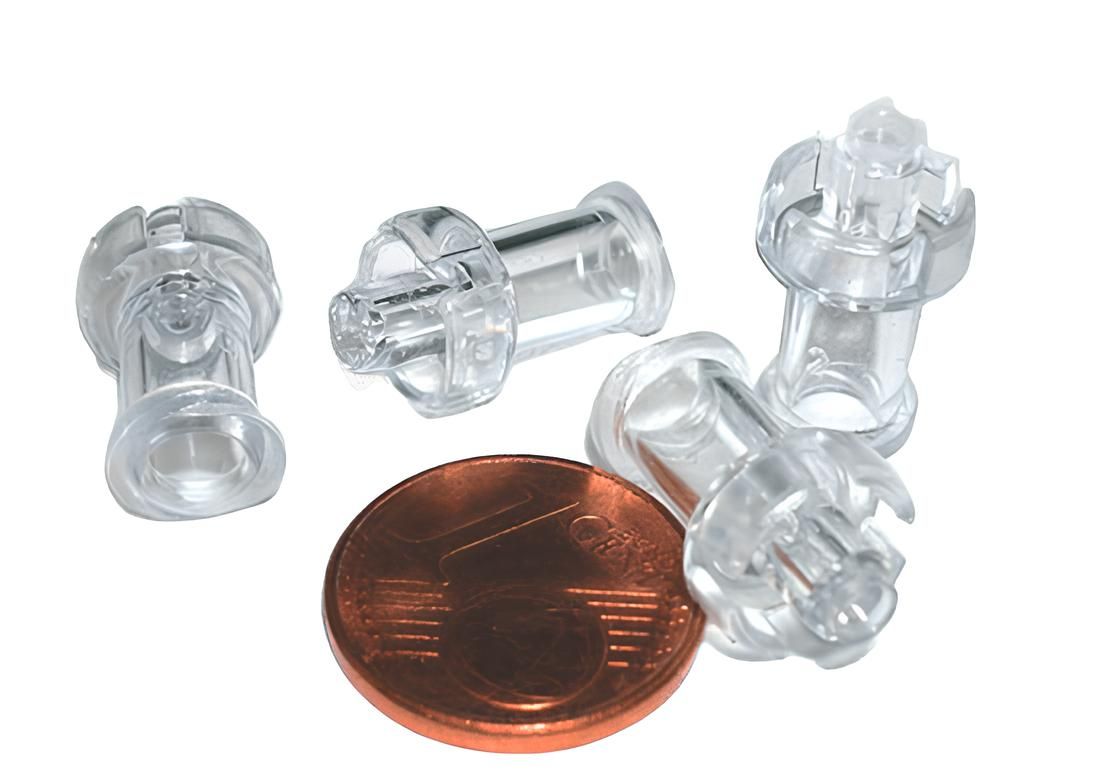
Production of a transparent catheter connector manufactured under ISO Class 6 cleanroom conditions.
Technical Data
Part type: Catheter coupling
Material: PC
Part weight: 0.40 g
Shot weight: 4.5 g
Machine: BOY 22 A
Screw diameter: 18 mm
Cycle time: 12.7 s
Number of cavities: 4
Runner system: Pin gate, runner distributor
Case Study 7 - Microsurgical Gripper (Greifzange)
Application Description
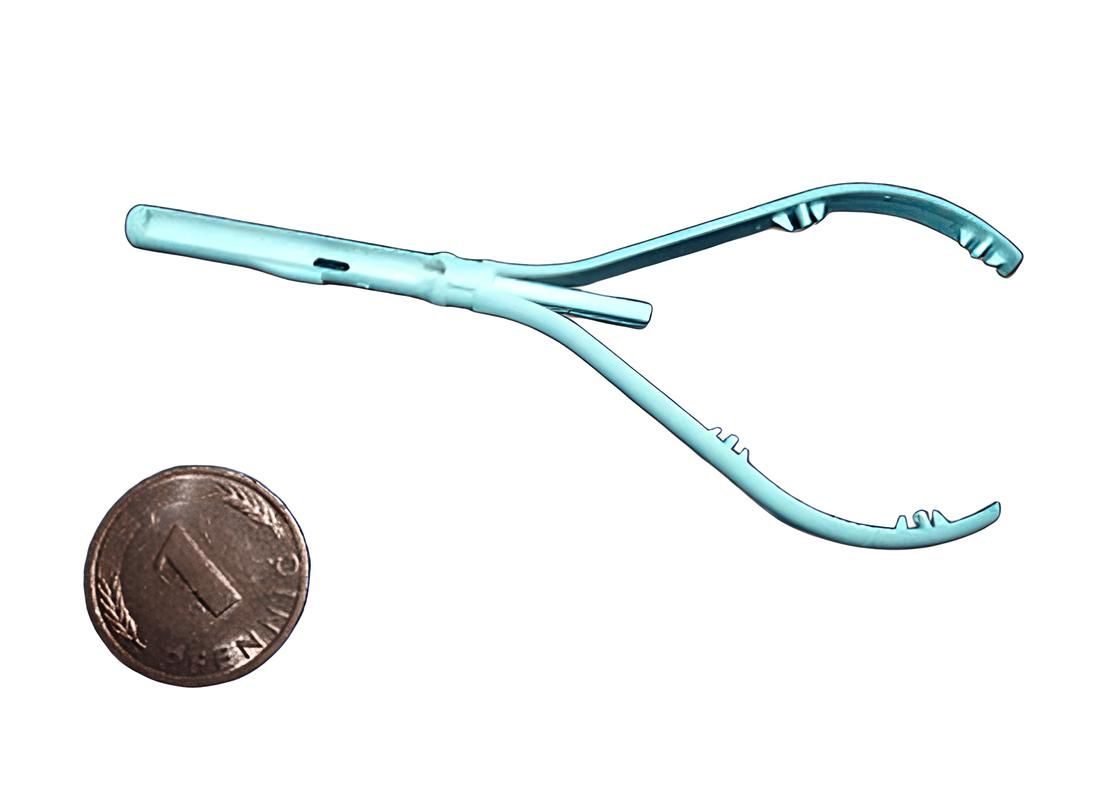
Production of a thin-walled microsurgical gripper featuring a 0.6 mm through-hole diameter.
Technical Data
Part type: Microsurgical gripper
Material: PSU (Polysulfone)
Part weight: 0.655 g
Shot weight: 2.365 g
Machine: BOY 30 A - 52
Screw diameter: 16 mm
Cycle time: 10.2 s
Number of cavities: 1
Overall Evaluation - Results from Medical Case Studies
These medical injection molding case studies clearly demonstrate the following capabilities of Dr. BOY injection molding machines:
- Safe processing of extremely expensive and sensitive biopolymers
- High repeatability at micro-gram part weights
- Compatibility with cleanroom and sterile production environments
- Stable processes for insert molding and multi-component medical parts
- Short cycle times with high cavity counts
Conclusion - Why Choose Dr. BOY for Medical Injection Applications?
Dr. BOY injection molding machines are not merely compact production units for medical parts. They represent a comprehensive technology platform delivering high process reliability, stable processing of biocompatible materials, and long-term production repeatability. These real industrial case studies clearly demonstrate why Dr. BOY is a trusted solution for medical implants, catheter components, and microsurgical applications.