Product Descriptions
Case Study Approach in Elastomer Injection Molding
Dr. BOY injection molding machines are widely used in elastomer injection applications where high process stability, precise pressure control, and a low-vibration mechanical design are essential. Compared to thermoplastics, elastomer materials exhibit different flow characteristics, typically longer cycle times, and often more demanding demolding conditions.
This case study compilation focuses on real industrial elastomer applications produced on Dr. BOY injection molding machines using TPE, FKM, and NBR materials. The objective is not only to present finished parts, but also to demonstrate how machine selection, screw diameter, cycle time, cavity configuration, runner design, and process challenges are successfully managed using Dr. BOY technology, supported by numerical data.
Case Study 1 - TPE End-Cap Overmolding on EPDM Profiles (Automotive)
Application Description
End-cap overmolding of hollow EPDM automotive window profiles using TPE material. This application represents a typical elastomer-on-elastomer overmolding process.
Technical Data
Part type: Profile end cap
Base profile: EPDM
Injected material: TPE
Part weight: 2.0 g
Shot weight: 4.5 g
Injection molding machine: BOY 22 A VV
Screw diameter: 18 mm
Cycle time: 22 s
Number of cavities: 1
Runner type: Sprue pin gate
Process Challenges
Secure fixation of the EPDM profile inside the mold
Reliable adhesion of TPE to the EPDM surface
Control of flash and overflow
Dr. BOY Advantage
Precise injection control and balanced clamping force ensured homogeneous TPE coverage of the EPDM profile, achieving surface quality that meets automotive industry standards.
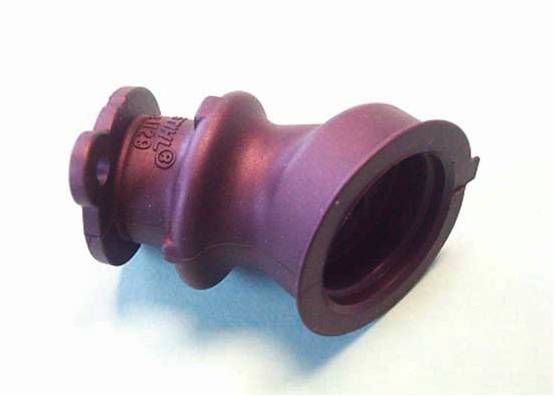
Case Study 2 - FKM Elastomer Intake Connector (Ansaugstutzen)
Application Description
An intake connector manufactured from FKM (fluoroelastomer) for engine and industrial systems requiring high temperature and chemical resistance.
Technical Data
Part type: Intake connector (Ansaugstutzen)
Material: FKM elastomer
Part weight: 17.5 g
Shot weight: 43 g
Injection molding machine: BOY 50 M
Screw diameter: 38 mm (elastomer plasticizing unit)
Cycle time: 45 s
Number of cavities: 2
Runner type: Cold runner with distributor
Process Challenges
High viscosity elastomer flow
Long cycle times
Requirement for flashless production
Dr. BOY Advantage
Automatic holding pressure transition based on cavity pressure enabled flash-free production while preserving the shape and surface integrity of the elastomer part.
Case Study 3 - NBR-Based 230 V Cable Plug Housing
Application Description
A cable plug housing made from NBR elastomer, designed for electrical applications requiring high mechanical strength and reliable insulation.
Technical Data
Part type: Cable plug housing (230 V)
Material: NBR
Part weight: 48.15 g
Shot weight: 192.6 g
Injection molding machine: BOY 80 M
Screw diameter: 42 mm (elastomer unit)
Cycle time: 67 s
Number of cavities: 4
Runner type: Cold runner
Process Challenges
High shot weight
Balanced filling in multi-cavity tooling
Dimensional stability of the elastomer part
Dr. BOY Advantage
High mechanical rigidity and automation-ready machine design enabled stable series production with consistent quality, even at high shot volumes.
Case Study 4 - TPE (Santoprene) Filter Gasket for Small-Batch Production
Application Description
A large-volume filter gasket made from TPE (Santoprene), used in industrial filtration systems and characterized by complex demolding geometry.
Technical Data
Part type: Filter gasket
Material: TPE (Santoprene)
Part weight: 182.4 g
Shot weight: 189.7 g
Injection molding machine: BOY 90 A
Screw diameter: 48 mm
Cycle time: 53 s (semi-automatic)
Number of cavities: 1
Runner type: Runner bar with distributor
Process Challenges
Large, flexible part geometry
Complex demolding requirements
Process repeatability in small-batch production
Dr. BOY Advantage
Balanced injection behavior and controlled cycle management allowed the large elastomer part to be produced without deformation and with high dimensional stability.
Overall Evaluation - Results from Dr. BOY Elastomer Case Studies
These elastomer case studies clearly demonstrate the strengths of Dr. BOY injection molding machines in elastomer processing:
Compatibility with a wide range of elastomers including TPE, FKM, and NBR
Broad application range from small parts to high shot-weight elastomer components
Flash-free production with excellent surface quality
Stable process control even with long cycle times
Proven suitability for automotive, electrical, and industrial applications
Conclusion - Why Choose Dr. BOY for Elastomer Injection Applications?
Dr. BOY injection molding machines provide more than just equipment for elastomer processing; they deliver a reliable production platform focused on process stability, surface quality, and long-term manufacturing consistency. These real industrial case studies clearly demonstrate why Dr. BOY is a trusted solution partner for elastomer injection applications across multiple industries.