Product Descriptions
Silicone and Organic Residue Removers
Silicone-based mold release agents, lubricants and maintenance products used in plastic, rubber, metal-processing and other industrial operations can gradually leave residues on molds, equipment and component surfaces. These residues may create a visible film and can also interfere with the adhesion of paints, adhesives, printing inks and coatings.
In addition to silicone contamination, organic oils, greases and general process residues can create problems during surface preparation and maintenance. Standard cleaners may not remove all of these deposits effectively. A cleaning product specifically developed for silicone and organic residues is therefore required.
ACCA silicone and organic residue removers are developed to help clean silicone residues, organic oils and general process contamination from metals and compatible plastic surfaces. Available in liquid and ready-to-use aerosol forms, the products support both large-area and localized cleaning operations.
Principal benefits
* Helps remove silicone residues from treated surfaces.
* Effective on organic oils, greases and general process contamination.
* Supports the cleaning of molds, equipment and metal surfaces.
* Assists with surface preparation before painting, bonding and printing.
* Can be used to remove residues from silicone-based mold release agents.
* Available in liquid and aerosol versions for different applications.
* The aerosol version provides localized and controlled application.
* The liquid version can be used on larger surfaces and in suitable cleaning systems.
* Helps eliminate visible films and oily surface layers.
* Provides practical use during maintenance and production changes.
Application areas
ACCA silicone and organic residue removers can be used in applications including:
* Plastic injection molds
* Rubber and elastomer molds
* Metal mold surfaces
* Processes using silicone-based mold release agents
* Plastic and metal components requiring subsequent painting
* Surfaces requiring adhesive bonding
* Surface preparation before screen or pad printing
* Components requiring subsequent coating
* Machine and equipment surfaces
* Maintenance and refurbishment operations
* Cleaning between production changes
* Metal surfaces contaminated with silicone films
* Industrial surfaces contaminated with organic oils and greases
* Localized cleaning on compatible plastics
Plastic materials differ significantly in their chemical resistance. Compatibility should therefore be tested on a small, inconspicuous area before large-scale application.
SIL REMOVER HD 142 Liquid
SIL REMOVER HD 142 Liquid is developed for removing silicone and organic residues. In addition to silicone contamination, it is effective on organic oils and general process dirt.
Its liquid format can be considered for large-area cleaning, cloth application, suitable spray systems and controlled industrial-cleaning operations. The application method should be selected according to the surface area, contamination level and production conditions.
The product can be used on metals and many plastic materials. However, plastic surfaces should be tested for discoloration, dulling, swelling or other surface changes before use.
Benefits of the liquid version
* Controlled application on large surfaces
* Suitable for manual use or appropriate industrial systems
* Application quantity can be adjusted according to requirements
* Economical use during mold and equipment maintenance
* Allows repeated treatment of surfaces with heavy silicone or organic contamination
SIL REMOVER HD 142 Aerosol - 500 ml
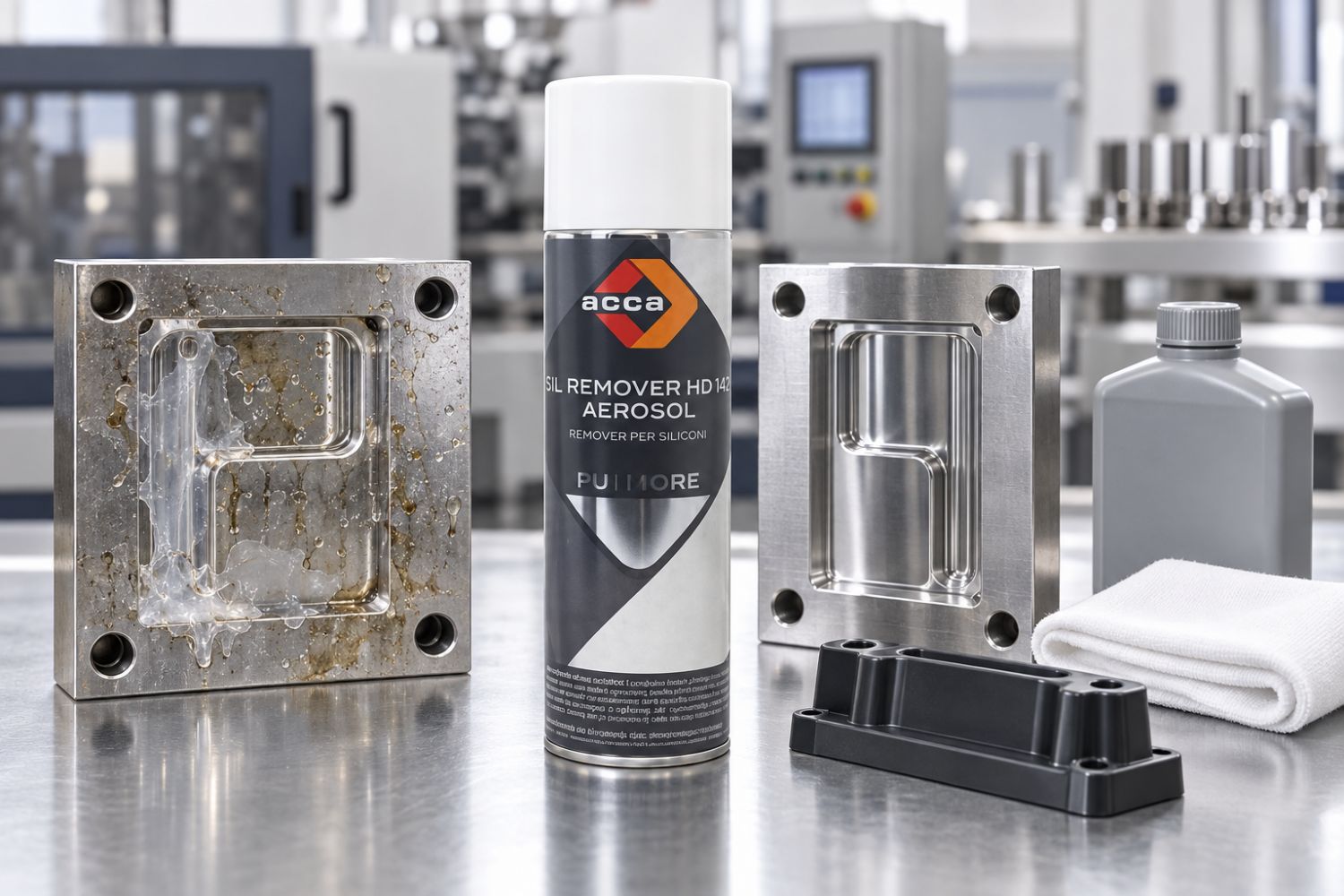
SIL REMOVER HD 142 Aerosol is the ready-to-use spray version of the product. It provides practical localized cleaning of silicone residues, organic oils and general process contamination.
The aerosol package facilitates controlled application to mold cavities, channels, corners and difficult-to-access surfaces. It is suitable for mold changes, maintenance operations, production trials and cleaning small areas.
After application, sufficient time should be allowed for the residue to dissolve. The dissolved contamination should then be removed using a clean, lint-free cloth. The operation may be repeated depending on the level of contamination.
Benefits of the aerosol version
* Ready-to-use packaging
* Localized and controlled application
* Access to difficult-to-reach areas
* Rapid use during maintenance and production changes
* No additional preparation or mixing required
* Portable and easy to apply
Why are silicone residues a problem?
Silicones have low surface energy and strong sliding properties. Even a very small quantity of silicone contamination can therefore affect subsequent processing.
Residual silicone may cause:
* Fish eyes and craters in painted surfaces
* Poor adhesion of paints and coatings
* Reduced adhesive-bond strength
* Spreading and adhesion problems with printing inks
* Irregularities in coated surfaces
* Oily or slippery component surfaces
* Residue accumulation on molds and equipment
* Surface defects during subsequent production
It is therefore important to verify that silicone contamination has been removed before painting, adhesive bonding, printing or coating.
Recommended application approach
Loose contamination should first be removed mechanically from the surface. SIL REMOVER HD 142 can then be applied in liquid or aerosol form according to the size of the area and level of contamination.
The product should be applied to the residue in a controlled quantity and allowed sufficient time to act. Dissolved contamination should be removed using a clean, lint-free cloth, wiping in one direction. Reusing the contaminated side of a cloth can spread dissolved silicone back over the surface.
Where necessary, repeat the process using fresh product and a clean cloth. After cleaning, allow the surface to dry completely and verify that silicone contamination has been removed before continuing with the next production operation.
Application precautions
* Review the technical data sheet and safety data sheet before use.
* Ensure adequate ventilation in the working area.
* Use suitable gloves, eye protection and personal protective equipment.
* Apply to hot surfaces only when permitted by the technical documentation.
* Perform a compatibility test on plastics, painted surfaces and coatings.
* Use clean, lint-free cloths.
* Replace cloths frequently to avoid redistributing dissolved contamination.
* Do not apply paint or adhesive before all cleaning residues have been removed.
* Keep aerosol containers away from flames and excessive heat.
* Thick or fully cured silicone deposits may require preliminary mechanical removal.
Verifying the cleaning result
The absence of visible silicone does not necessarily mean that the surface is completely clean. Verification is recommended for critical painting, bonding and printing applications.
Possible verification methods include:
* Water-break or surface-wetting tests
* Surface-tension measurement
* Test inks or surface-energy pens
* Trial painting
* Adhesive-bond strength testing
* Screen or pad-printing trials
* Visual surface inspection
Polmak Plastik supports customers in evaluating the residue type, selecting the appropriate ACCA product and determining the correct cleaning method according to subsequent processing requirements.