Product Descriptions
Food-Compatible Lubricants and Technical Maintenance Products
ACCA food-compatible lubricants and technical maintenance products are developed for conveyors, chains, rollers, bearings, pumps, valves, hinges and moving mechanisms in food and beverage production facilities. NSF H1-certified, FDA-grade, PTFE-containing, water-resistant and aerosol product options support maintenance safety and equipment reliability.
Machinery and equipment in food-production facilities may operate under exposure to water, steam, cleaning chemicals, changing temperatures and frequent washdown cycles. These conditions can remove conventional oils, wash grease away and lead to wear or corrosion.
Standard industrial lubricants may not be suitable where there is a possibility of incidental contact with food or packaging. Lubricants with the appropriate food-industry classification should be selected for these points.
NSF H1 classification applies to lubricants that may be used where incidental food contact is technically unavoidable. It does not mean that the lubricant can be used as a direct food additive or allowed to remain in continuous contact with food.
The term FDA-grade ingredients indicates that the formulation contains components intended for suitable food-industry applications. Current certification, registration status and permitted use should be verified using the applicable technical documents.
The ACCA range includes liquid and aerosol white oils, PTFE-containing greases, washout-resistant maintenance products, penetrating lubricants and cleaner-lubricants for bottle and packaging conveyors.
Conveyor Lubricants
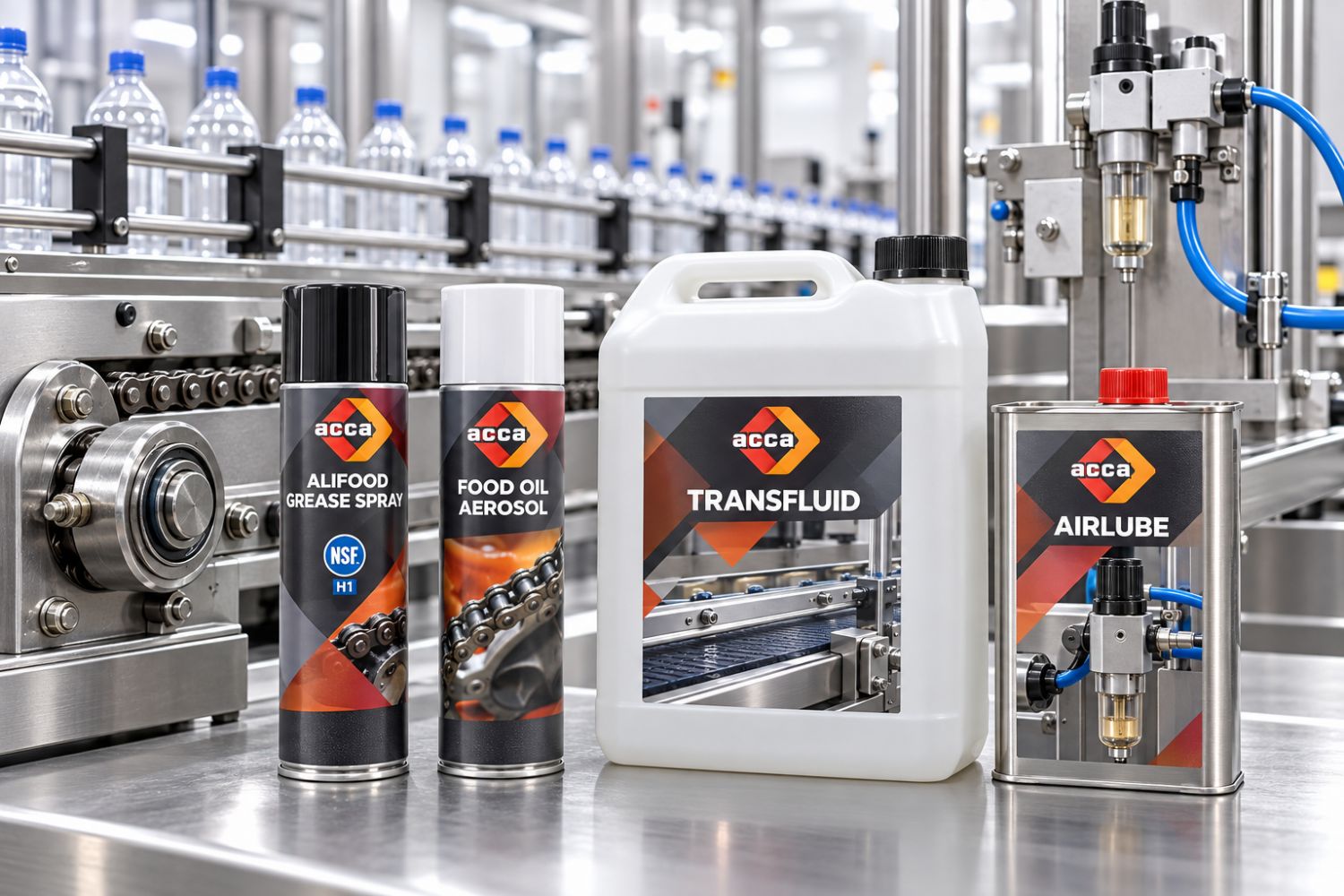
TRANSFLUID
A concentrated cleaner-lubricant developed for conveyor belts in food and beverage production lines. Its soap-based formulation provides both lubrication and cleaning action on the belt and surrounding areas.
With correct dosing, its concentrated formulation offers economical use. It supports consistent movement of bottles and packaging while helping reduce friction, noise and conveyor load.
TRANSFLUID D
A soap-based product developed to lubricate and clean conveyor belts. It helps control contamination accumulating on belt surfaces and mechanical areas below the conveyor.
It supports smoother packaging movement and contributes to lower friction within the conveyor system.
TRANSLUBE A
A synthetic conveyor lubricant developed for glass, PET and PVC bottles, metal cans and other packaging. Its amine-based formulation offers high lubricating performance.
Its non-foaming characteristics support controlled operation in automatically dosed and circulating conveyor systems.
Food-Industry Oils
FOOD OIL HD 90
A white paraffinic oil developed for lubricating machinery and equipment in the food industry. It is colourless, odourless and inert on surfaces.
The ACCA catalogue describes it as being made from FDA-grade paraffinic oils that do not require hazard symbols. It can be considered for suitable oil-bath, drip-feed or manual lubrication applications.
Main characteristics:
- White paraffinic oil
- Suitable for food-industry machinery
- Colourless and odourless
- Inert on surfaces
- Described by ACCA as FDA grade
- Suitable for maintenance points requiring liquid oil
FOOD OIL AEROSOL HD 90
The aerosol version of FOOD OIL. It provides controlled application to difficult-to-reach areas, chains, joints and limited lubrication points.
The product is based on white paraffinic oils and is colourless, odourless and inert on surfaces. Its aerosol format simplifies accurate application during maintenance.
Food-Industry Greases
ALIFOOD GREASE HD 91
An NSF H1-certified white food-industry grease containing PTFE. It is developed for lubrication points where incidental food contact may occur.
It can be used for general lubrication of conveyors, rollers, hinges, pumps, valves, O-rings and mechanical components. It resists water washout, is odourless and is described in the catalogue as having no dropping point.
Main characteristics:
- NSF H1 certified
- White food-compatible grease
- Contains PTFE
- Resistant to water washout
- Odourless
- Suitable for conveyors, rollers, pumps and valves
- Suitable for O-rings and hinges
ALIFOOD GREASE SPRAY HD 91
The aerosol version of ALIFOOD GREASE. It is NSF H1 certified and enables controlled application to difficult-to-reach maintenance points.
Its white PTFE-containing grease is suitable for chains, rollers, hinges, pumps, valves and O-rings. Resistance to water washout helps maintain the lubricating film in frequently cleaned production areas.
FOOD GREASE HD 91
A white PTFE-containing grease developed for food-industry equipment. The ACCA catalogue states that it contains FDA-grade ingredients.
It is inert on surfaces and suitable for general-purpose lubrication. The catalogue identifies it as grade 2 and describes it as having no dropping point.
FOOD GREASE AEROSOL HD 91
The aerosol version of FOOD GREASE. The white PTFE-containing grease can be applied to difficult-to-reach lubrication points.
Its FDA-grade ingredients and aerosol format provide convenient maintenance of chains, rails, joints, hinges and similar areas.
UNIVERSAL GREASE AEROSOL HD 91
A multipurpose aerosol grease developed for pins, hinges, screws, bolts and other general mechanical points in food facilities.
It provides strong resistance to water and steam. Its colourless, odourless formulation without hazardous additives makes it suitable for general maintenance applications in food-production environments.
Food-Compatible Technical Maintenance Products
ALISBLOC AEROSOL HD 124
An NSF H1-certified penetrating and releasing maintenance lubricant. It helps loosen seized connections, bolts and mechanical components.
It provides strong penetrating and lubricating performance and can be used at maintenance points where incidental food contact may occur.
FOOD LUBE PTFE AEROSOL HD 124
A white, synthetic, semi-fluid lubricant containing PTFE. It is developed for lubricating machinery and systems in the food industry.
It does not drip, stain or dry out after application. These characteristics help it form a persistent film on vertical surfaces, rails, slides, chains and limited lubrication points.
Importance of Food-Compatible Lubricant Selection
Not every lubrication point in a food-production facility has the same risk level. The possibility of contact with food, equipment temperature, exposure to water and steam, load and speed must be evaluated together.
NSF H1-certified products can be used where incidental contact may occur. Different classifications may apply to equipment located in food-production areas where food contact is excluded.
Incorrect lubricant selection may cause:
- Food or packaging contamination
- Rapid washout of the lubricant
- Premature wear of bearings and mechanisms
- Increased friction on chains and conveyors
- Accumulation of dust and contamination
- Non-conformity during food-safety audits
- Performance loss caused by mixing incompatible lubricants
Main Application Areas
- Food and beverage machinery
- Bottle and packaging conveyors
- Glass, PET and PVC bottle lines
- Metal-can conveying systems
- Chains and rails
- Rollers and bearings
- Pumps and valves
- Hinges, pins and joints
- O-rings and seals
- Filling and packaging machines
- Dairy and beverage facilities
- Meat and prepared-food equipment
- Bakery and flour-processing lines
- Mechanisms exposed to washdown and steam
- Maintenance of seized bolts and connections
Key Benefits
- Provides solutions for different lubrication points in food facilities
- Includes NSF H1-certified options
- Offers oils and greases containing FDA-grade ingredients
- PTFE additives help reduce friction and wear
- Provides grease options resistant to water and steam washout
- Includes colourless, odourless and white alternatives
- Offers liquid, grease and aerosol application formats
- Supports friction and foam control on conveyors
- Enables controlled application to difficult-to-reach areas
- Contributes to equipment life and production continuity
Product Selection
TRANSFLUID or TRANSFLUID D can be considered where conveyor cleaning and lubrication are required together.
TRANSLUBE A can be selected for glass, PET, PVC and metal-can lines requiring a non-foaming synthetic product.
FOOD OIL HD 90 is suitable where liquid white oil is required, while FOOD OIL AEROSOL HD 90 is suitable for localised and difficult-to-reach points.
ALIFOOD GREASE or ALIFOOD GREASE SPRAY should be selected where an NSF H1-certified, PTFE-containing and washout-resistant grease is required.
FOOD GREASE products can be considered for general-purpose white grease containing FDA-grade ingredients.
NSF H1-certified ALISBLOC AEROSOL can be used to loosen seized bolts and mechanisms.
FOOD LUBE PTFE AEROSOL can be selected where a non-dripping, non-staining and non-drying semi-fluid PTFE lubricant is required.
The following criteria should be considered:
- Risk of contact between the lubrication point and food
- Required certification or customer specification
- Load, speed and operating temperature
- Exposure to water, steam and cleaning chemicals
- Requirement for liquid oil, grease or aerosol
- Vertical or horizontal application
- Odour, colour and staining requirements
- Equipment manufacturer recommendations
- Seal and elastomer compatibility
- Compatibility with the existing lubricant
Lubrication Programme and Application
Lubrication points should be identified within the facility food-safety and maintenance plan. Product name, application point, quantity and maintenance frequency should be documented.
Before changing lubricants, the previous product should be removed as completely as possible. Mixing incompatible oils and greases may cause consistency loss, separation and reduced lubrication performance.
Over-lubrication should be avoided. Even an NSF H1-certified product should only be applied in the minimum technically necessary quantity. Direct contact with food or packaging should be prevented.
Application and Safety Statement
Food-compatible and NSF H1-certified lubricants are not edible products. They are intended only for situations where incidental contact is technically unavoidable.
Current NSF registration, technical data sheets and safety data sheets should be checked before use. The term FDA-grade ingredients should not be interpreted as approval for unlimited food contact.
Aerosols must not be applied near open flames, hot surfaces or active electrical sources. Equipment should be stopped and isolated before maintenance, and the facility lockout and tagout procedure should be followed.