Product Descriptions
Ultrasonic, Tumbling and Biological Cleaners
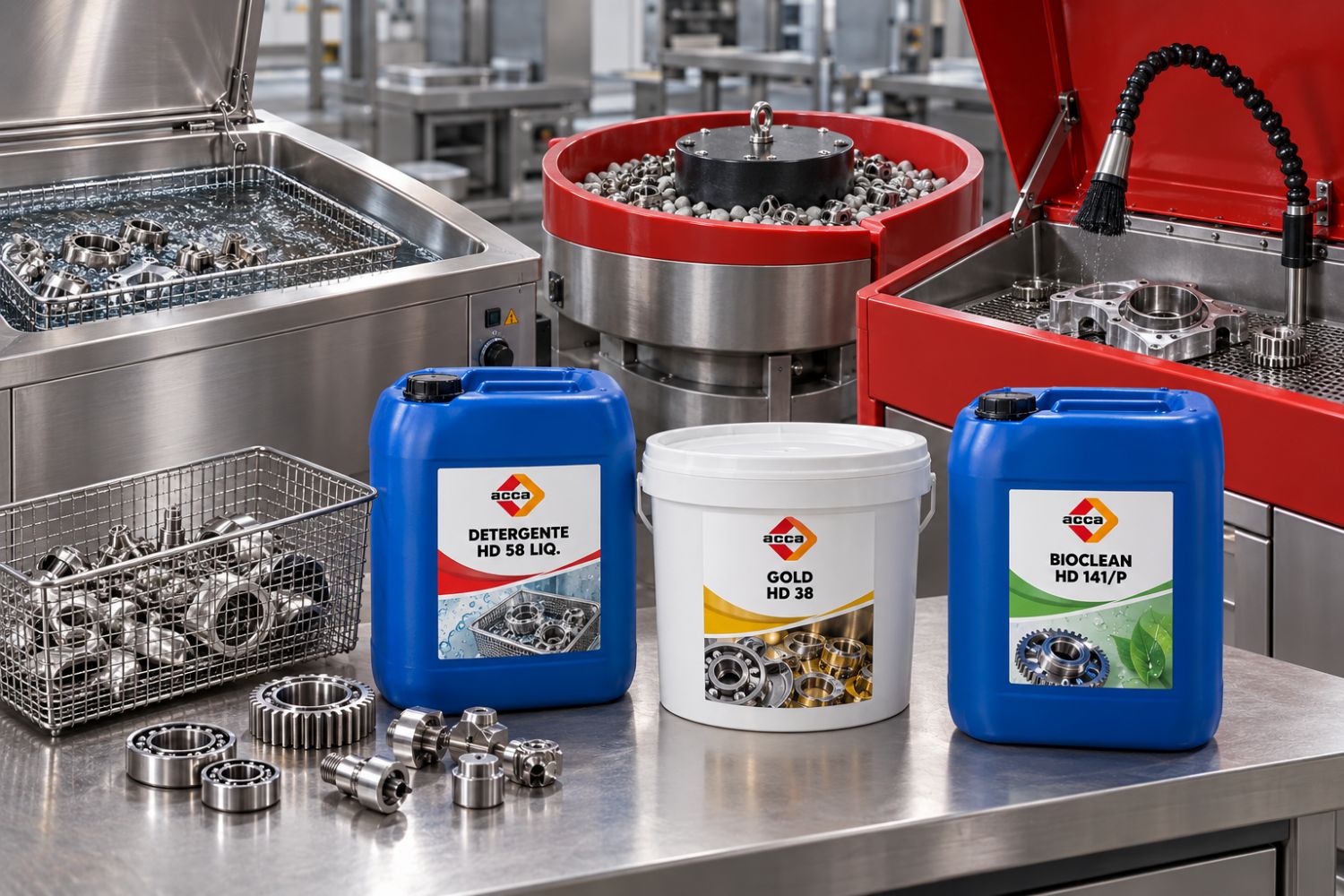
ACCA ultrasonic, tumbling and biological cleaners are developed to remove oil, grease, polishing compounds, chips and process residues from metal components, precision parts, jewellery and mechanical equipment. The range offers products for ultrasonic cleaning machines, wet tumbling and vibratory finishing systems, and heated biological parts washers.
As industrial components become more geometrically complex, blind holes, channels, threads, recesses and difficult-to-reach areas become harder to clean using conventional methods. Ultrasonic cleaning uses the effect of microscopic cavitation bubbles created in a liquid to release contamination from surfaces.
Successful ultrasonic cleaning does not depend only on equipment power. The cleaning chemical must dissolve contamination, suspend particles removed from the surface, avoid excessive foam and remain compatible with the processed material.
In tumbling and vibratory finishing, components move together with suitable mechanical abrasive or polishing media. The cleaning compound helps remove metal chips, surface contamination and residues generated during processing.
Biological cleaning systems use non-pathogenic microorganisms that support the breakdown of petroleum-based oils and grease. These systems can be considered as alternatives to solvent degreasing and certain strong industrial cleaning methods.
The ACCA range includes general-purpose ultrasonic detergents, neutral-pH products for sensitive metals and jewellery, low-foam cleaners for heated systems, wet-tumbling compounds and biological degreasers.
Products
DETERGENTE HD 58 LIQUIDO
A liquid cleaner specifically developed for ultrasonic washing machines. It emulsifies and dissolves particles released from the surface, helping prevent contamination from redepositing on the component.
Its rapid action and economical use make it suitable for ultrasonic cleaning of production parts, maintenance components and complex geometries.
Main characteristics:
- Formulated specifically for ultrasonic machines
- Emulsifies and dissolves contamination
- Supports cleaning of difficult-to-reach areas
- Rapid cleaning action
- Economical use
- Suitable for batch parts cleaning
ELISIR HD 184
A strong neutral-pH cleaner and degreaser developed for use in heated ultrasonic systems. It is particularly suitable for removing polishing compounds in jewellery applications.
It can be used on gold, silver and various metal types. Its neutral pH makes it suitable for applications involving sensitive surfaces. Compatibility with alloys, coatings and gemstones should nevertheless be verified before use.
Main characteristics:
- Neutral-pH formulation
- Suitable for heated ultrasonic systems
- Removes polishing compounds
- Suitable for metals including gold and silver
- Designed for jewellery and precision-component cleaning
- Strong cleaning and degreasing action
ULTRAWASH F HD 140
A medium-alkaline, low-foam cleaner developed for heated automatic washing systems. It can be used on steel, iron, light alloys and yellow metal alloys.
Its low-foam performance supports stable operation in spray, circulation and automatic washing systems. It provides a versatile solution where different metal types are cleaned in the same plant.
Main characteristics:
- Medium-alkaline cleaner
- Low and controlled foam
- Suitable for steel and iron
- Compatible with light alloys and yellow metals
- Suitable for heated automatic systems
- Designed for multi-metal cleaning applications
GOLD HD 38
A cleaner developed for wet tumbling and vibratory finishing machines. It helps remove chips, processing residues and contamination from mechanical components, costume jewellery, gold and other metal parts.
It is used together with spheres, plastic or ceramic cones, needles, wooden media and other suitable mechanical finishing materials. It can support cleaning, surface smoothing and polishing operations.
Main characteristics:
- Suitable for wet tumbling machines
- Compatible with vibratory finishing systems
- Used with mechanical finishing media
- Helps remove chips and surface contamination
- Suitable for mechanical components and jewellery
- Supports surface smoothing and polishing
BIOCLEAN HD 141 P
A concentrated biological degreaser developed as an alternative to solvents and conventional industrial degreasers. Its formulation contains non-pathogenic microorganisms that support the biological breakdown of hydrocarbons and fats.
Its concentrated form can be prepared according to application conditions and technical instructions. It can be used in heated biological parts washers for regular maintenance and mechanical-component cleaning.
Main characteristics:
- Concentrated biological degreaser
- Formulated with non-pathogenic microorganisms
- Supports the breakdown of hydrocarbons and fats
- Provides an alternative to solvent cleaning
- Suitable for biological parts-washing systems
- Designed for maintenance and parts cleaning
BIOCLEAN READY HD 141 P
A ready-to-use biological degreaser. Its formulation contains non-pathogenic microorganisms that help break down hydrocarbons and fats.
Its ready-to-use format requires no concentration preparation and provides convenient use for initial filling, topping up or daily maintenance of biological parts-washing systems.
Main characteristics:
- Ready-to-use biological degreaser
- Formulated with non-pathogenic microorganisms
- Supports the breakdown of hydrocarbons and grease
- Requires no dilution or concentration preparation
- Provides an alternative to solvent cleaning
- Suitable for daily maintenance applications
BIO TANK CLEANER N
BIO TANK CLEANER N is a medium-size heated parts-washing unit developed for use with biological cleaners. It maintains the cleaning solution at a suitable temperature and allows components to be washed under controlled conditions.
According to the ACCA catalogue, the system has a 65-litre tank capacity. Combining the biological degreaser with the dedicated washing equipment helps create a more stable environment for microorganism activity.
How Ultrasonic Cleaning Works
An ultrasonic cleaner produces high-frequency sound waves in the cleaning liquid. These waves create very small bubbles that form and collapse rapidly. This effect, known as cavitation, helps release contamination from surfaces and difficult-to-reach areas.
The following factors should be considered together:
- Chemical composition of the cleaner
- Bath concentration
- Bath temperature
- Ultrasonic frequency and power
- Metal and coating type
- Nature and severity of contamination
- Contact time
- Component placement in the basket
- Rinsing and drying conditions
Using excessive product does not always improve cleaning. High concentrations may generate foam, make rinsing difficult or leave surface residues. Process parameters should be determined according to the technical instructions.
Tumbling and Vibratory Finishing
In tumbling and vibratory finishing, components move together with suitable processing media. Spheres, cones, needles and other mechanical media provide physical action, while chemical products such as GOLD HD 38 help remove contamination, metal residues and particles generated during processing.
The chemical product and mechanical media should be selected according to the required result:
- Deburring
- Surface smoothing
- Polishing
- Oxide and contamination removal
- Edge radiusing
- Preparation for subsequent coating
Biological Parts Cleaning
Biological cleaners use microorganism activity to break down petroleum-based oils and grease released from component surfaces. This process can help manage the oil load in the cleaning bath and support longer bath use.
For stable biological operation, suitable temperature, pH, oxygenation and liquid level should be maintained. Uncontrolled addition of solvents, disinfectants, biocides, strong acids or strong alkalis may reduce microorganism activity.
Biological products may not be suitable for every contamination type. Paint, resin, cured adhesive, heavy carbon deposits and inorganic scale may require different cleaning chemicals.
Recommended General Process Sequence
1. Component and Contamination Analysis
The material, coating, geometry and contamination type of the component are identified.
2. Cleaning Method Selection
Ultrasonic cleaning can be considered for complex geometries and sensitive components, tumbling for parts requiring deburring or surface smoothing, and biological cleaning for routine maintenance of oily components.
3. Product Selection
DETERGENTE HD 58 LIQUIDO can be used for general ultrasonic cleaning, ELISIR HD 184 for sensitive metals and polishing compounds, and ULTRAWASH F HD 140 for heated low-foam automatic systems.
GOLD HD 38 can be selected for tumbling and vibratory finishing. Concentrated BIOCLEAN HD 141 P or ready-to-use BIOCLEAN READY HD 141 P can be considered for biological systems.
4. Process Adjustment
Concentration, temperature, contact time, ultrasonic power or tumbling cycle is adjusted according to the technical documentation.
5. Rinsing and Drying
Where required, components are rinsed with clean water and dried using a suitable method. Water marks and recontamination should be prevented.
Main Application Areas
- Ultrasonic parts-washing machines
- Precision mechanical components
- Components with blind holes and complex geometries
- Jewellery and costume jewellery
- Gold and silver components
- Removal of polishing compounds
- Removal of cutting oils and grease
- Wet tumbling machines
- Vibratory finishing systems
- Deburring and surface-smoothing processes
- Automotive and machinery components
- Maintenance and refurbishment workshops
- Biological parts-washing units
- Routine cleaning of maintenance parts
- Applications aiming to reduce solvent use
Key Benefits
- Helps clean difficult-to-reach areas
- Supports the cleaning effect of ultrasonic cavitation
- Provides a neutral-pH option for sensitive metals
- Low-foam products support stable operation of automatic systems
- Offers cleaners suitable for several metal types
- Supports tumbling and vibratory finishing
- Helps remove chips, polishing compounds and process residues
- Provides concentrated and ready-to-use biological options
- Offers alternatives to solvent-based cleaning
- Supports biological breakdown of hydrocarbons and fats
Product Selection
DETERGENTE HD 58 LIQUIDO is suitable for general-purpose ultrasonic parts cleaning.
ELISIR HD 184 can be selected for neutral-pH cleaning of sensitive metal components, gold, silver and polishing-compound residues.
ULTRAWASH F HD 140 can be considered for steel, iron, light-alloy and yellow-metal components in heated automatic systems where low foam is important.
GOLD HD 38 can be used with suitable mechanical media in wet tumbling and vibratory finishing applications.
BIOCLEAN HD 141 P is suitable where a concentrated biological product is preferred. BIOCLEAN READY HD 141 P can be selected when a ready-to-use solution is required.
The following criteria should be considered:
- Metal, alloy and coating type
- Whether contamination is oil, grease, polishing compound, chips or hydrocarbons
- Component size and geometry
- Ultrasonic, tumbling or biological cleaning system
- Bath temperature and contact time
- Foam level
- Rinsing and drying requirements
- Required surface appearance
- Subsequent coating, assembly or inspection process
Application and Safety Statement
The latest technical data sheet and safety data sheet should be reviewed for each product. Compatibility with metals and coatings should be verified through a controlled test on an inconspicuous area of the actual component.
Hands should not be placed directly into an ultrasonic bath while the unit is operating. Equipment operating and safety instructions must be followed.
Although biological cleaners contain microorganisms, standard hygiene and personal-protection measures must still be observed. Gloves and eye protection should be used, and products must not be transferred into food or beverage containers.