Product Descriptions
Antifoams and Industrial Process Additives
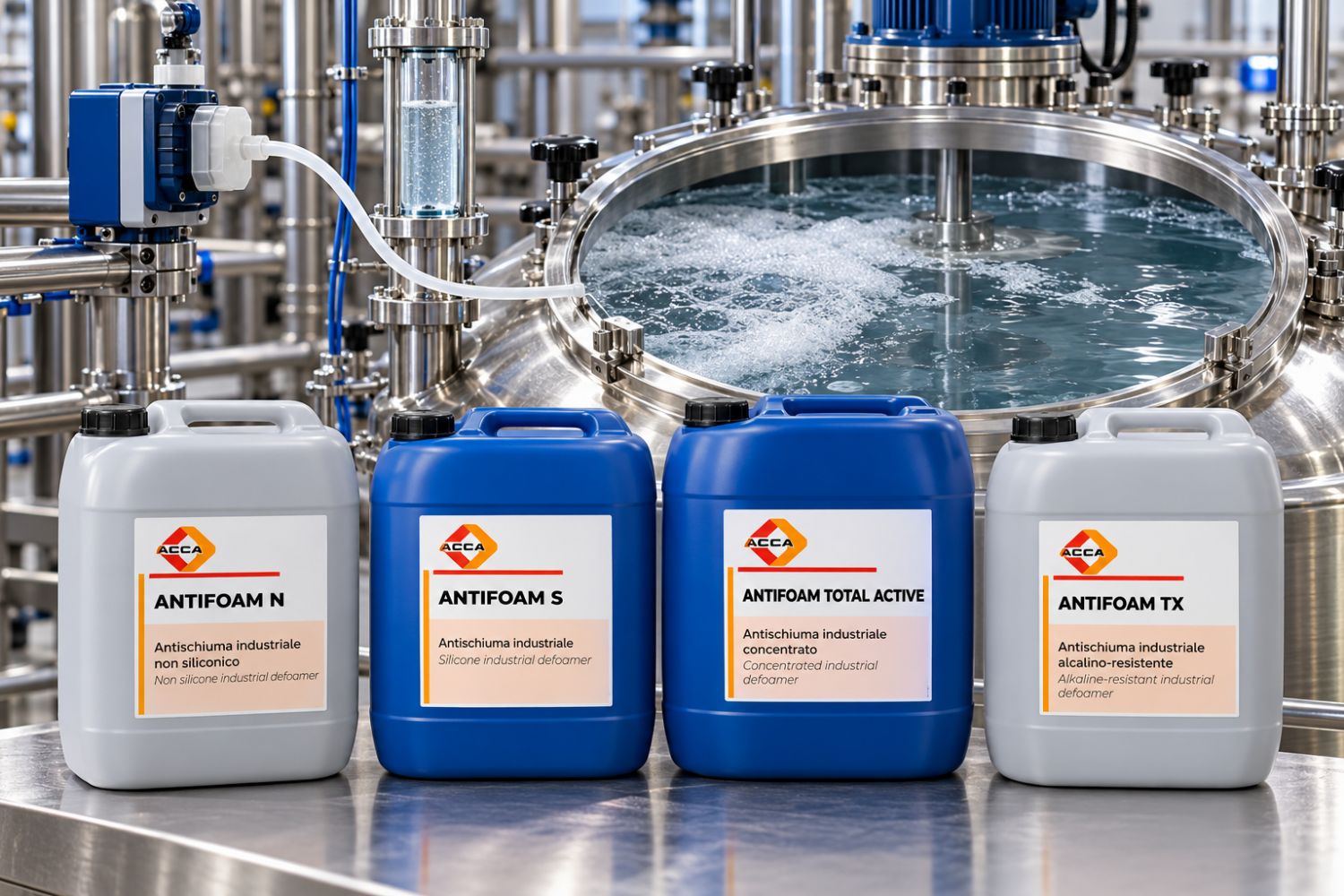
ACCA antifoams and process additives are developed to control foam in industrial washing systems, metalworking fluids, water-based production processes and highly alkaline baths. The range includes silicone, non-silicone, highly concentrated and alkaline-resistant defoamers, together with specialised additives for cleaning, stabilising and deodorising metalworking fluids and improving extreme-pressure performance.
Foam in industrial processes may be generated by surfactants, oils, organic contamination, high circulation rates, pump action, spray pressure or air entering the system. Uncontrolled foam can cause tank overflow, pump cavitation, measurement errors, insufficient surface contact and reduced production capacity.
Temporarily removing foam from the surface is not sufficient. The correct defoamer should destabilise foam bubbles, rapidly collapse existing foam and limit the formation of new foam. At the same time, it must be compatible with the process chemistry and subsequent production stages.
Silicone-based antifoams provide strong performance at low dosages in many systems. However, non-silicone products may be required for processes sensitive to silicone contamination, including painting, coating, bonding and printing. Highly alkaline baths require alkaline-resistant products capable of maintaining stability in aggressive chemical environments.
Metalworking fluids may also develop odour, microbial contamination, emulsion instability and insufficient extreme-pressure performance. ACCA process additives provide specialised solutions for system cleaning, emulsion maintenance, odour control and lubrication-performance support.
Products
ANTIFOAM N HD 42
A non-silicone industrial defoamer developed to prevent and reduce different types of foam.
It is effective at low concentrations and contains 20 percent active material. It can be considered for applications where silicone residue may interfere with subsequent painting, coating, bonding or printing.
Main characteristics:
- Non-silicone formulation
- Helps collapse existing foam
- Limits new foam formation
- Effective at low concentrations
- Contains 20 percent active material
- Suitable for silicone-sensitive processes
- Can be used in industrial washing and water-based processes
ANTIFOAM S HD 42
A silicone-based industrial defoamer developed to prevent foam formation and rapidly reduce existing foam in different industrial processes.
It is effective at low concentrations and contains 20 percent active material. It provides powerful and economical foam control where silicone does not interfere with the process or subsequent manufacturing stages.
Main characteristics:
- Silicone-based defoamer
- Rapid foam-collapse action
- Helps prevent foam formation
- Effective at low dosages
- Contains 20 percent active material
- Broad industrial application range
- Can be considered for circulation and spray systems
ANTIFOAM TOTAL ACTIVE HD 42
A concentrated industrial defoamer developed for demanding applications where standard products do not provide sufficient results. It helps control different types of foam.
It contains 100 percent active material and can be used at very low concentrations. Because of its high concentration, accurate and controlled dosing is essential.
Main characteristics:
- Highly concentrated defoamer
- Contains 100 percent active material
- Effective at very low dosages
- Suitable where standard antifoams are insufficient
- Helps control different foam types
- Low consumption through concentrated formulation
- Suitable for precise dosing systems
ANTIFOAM TX HD 42
An alkaline-resistant, silicone-based industrial defoamer developed for controlling foam in highly alkaline environments. It helps maintain chemical stability and antifoam performance in strong alkaline baths.
It is effective at low concentrations and contains 20 percent active material. It can be considered for heated alkaline parts-washing systems, strong degreasing baths and high-pH industrial processes.
Main characteristics:
- Alkaline-resistant formulation
- Silicone-based defoamer
- Suitable for high-pH processes
- Effective at low concentrations
- Contains 20 percent active material
- Can be used in heated alkaline washing systems
- Supports foam control in strong degreasing baths
EMULCLEAN HD 160 2
An active cleaner developed for cleaning metalworking-fluid systems and collection tanks. It helps remove dirt, deposits and process residues from the system.
According to the ACCA catalogue, it can be used without completely interrupting production. Its concentrated formulation is designed to provide effective cleaning at a low use rate.
Main characteristics:
- Dedicated cleaner for metalworking-fluid tanks
- Suitable for collection tanks and circulation systems
- Helps remove contamination and process residues
- Can be used without completely stopping production
- Concentrated formulation
- Simplifies system maintenance and fluid replacement
HD 160 1
A stabilising and decontaminating emulsion additive developed for mineral and semi-synthetic metalworking fluids. It helps reduce unpleasant odours that can develop in fluid tanks.
Its concentrated formulation provides effective process support at a low use rate. The product should be considered as part of an overall emulsion-maintenance programme.
Main characteristics:
- Suitable for mineral metalworking fluids
- Can be used in semi-synthetic emulsions
- Helps stabilise the emulsion
- Reduces unpleasant tank odours
- Decontaminating action
- Concentrated and effective formulation
HD 29 1
A process additive developed for decontaminating synthetic metalworking fluids. It helps reduce unpleasant odours in tanks and supports more hygienic operating conditions.
It can also be used for odour control in suitable water-based paint booths. The dosage should be determined according to system volume and technical recommendations.
Main characteristics:
- Decontaminating additive for synthetic metalworking fluids
- Odour control
- Supports hygienic process conditions
- Suitable for metalworking-fluid tanks
- Can be considered for water-based paint booths
- Controlled-concentration application
STEP HD 610
A water-miscible special additive formulated to improve the extreme-pressure performance of mineral and semi-synthetic metalworking fluids.
It helps increase lubricity and load-carrying capability in heavy cutting, threading, tapping and other metalworking operations performed under high loads.
Main characteristics:
- Water-miscible special process additive
- Helps improve extreme-pressure performance
- Suitable for mineral metalworking fluids
- Suitable for semi-synthetic metalworking fluids
- Designed for demanding metalworking operations
- Supports lubrication between the tool and workpiece
Why Does Foam Form?
The main causes of foam in industrial systems include:
- Surfactants in cleaning products
- Oil and organic contamination in the tank
- High pump flow and circulation
- Air entering through spray nozzles
- Low liquid level
- Incorrect product concentration
- Changes in bath temperature
- Process water with unsuitable hardness
- Mixing incompatible chemicals
- Biological contamination within the system
The underlying cause of foam should be identified before adding a defoamer. If foam is caused by a mechanical or process problem, chemical addition alone may not provide a permanent solution.
Selecting Silicone or Non-Silicone Antifoam
Silicone-based ANTIFOAM S can be considered for general industrial processes requiring strong and rapid foam control at low dosage.
ANTIFOAM N provides a non-silicone alternative for processes that may be sensitive to silicone contamination, including painting, coating, printing and bonding.
ANTIFOAM TX is developed for highly alkaline washing and degreasing baths.
ANTIFOAM TOTAL ACTIVE is suitable for demanding processes where conventional defoamers are insufficient and a strong effect at a very low dosage is required.
A silicone-based defoamer may create residues that cause defects during subsequent painting or coating. Product selection must therefore consider not only foam-control performance but also downstream processes.
Dosing and Application
Antifoams are generally effective at low concentrations. Excessive dosing may cause:
- Oily or slippery surface residue
- Reduced paint or coating adhesion
- Craters or fisheye-type surface defects
- Contamination of filtration systems
- Process-bath imbalance
- Unnecessary chemical consumption
Where possible, the product should be dosed in a controlled manner into the area where foam forms or where the liquid is moving. A small-scale trial should be carried out for new applications to determine the lowest effective dosage.
Using Process Additives
EMULCLEAN HD 160 2 can be used to clean metalworking-fluid systems and prepare them for fresh fluid.
HD 160 1 supports stability and odour control in mineral and semi-synthetic emulsions.
HD 29 1 can be considered as a decontaminating and odour-reducing additive for synthetic fluids and suitable water-based paint-booth applications.
STEP HD 610 can be used after technical evaluation where the extreme-pressure performance of an existing mineral or semi-synthetic metalworking fluid is insufficient.
Process additives cannot always restore an unsuitable or fully degraded fluid to serviceable condition. Fluid concentration, pH, microbiological condition, tramp-oil content and overall operating conditions should be evaluated together.
Main Application Areas
- Industrial parts-washing systems
- Heated alkaline washing baths
- Spray and circulation cleaning systems
- Metalworking-fluid tanks
- Mineral and semi-synthetic emulsions
- Synthetic metalworking fluids
- Water-based manufacturing processes
- Water-based paint booths
- Wastewater and process-water applications
- Chemical production tanks
- Highly alkaline degreasing baths
- Cutting, grinding and machining processes
- Heavy-duty metalworking operations
- Process-fluid maintenance and cleaning
Key Benefits
- Helps collapse existing foam rapidly
- Supports prevention of new foam formation
- Offers silicone and non-silicone options
- Provides a dedicated product for highly alkaline environments
- Includes a concentrated product effective at very low dosages
- Helps reduce the risk of tank overflow and production interruption
- Supports stable operation of pumps and spray systems
- Contributes to odour reduction in metalworking fluids
- Simplifies emulsion and system cleaning
- Helps improve extreme-pressure performance of metalworking fluids
Product Selection
ANTIFOAM N HD 42 can be selected where silicone must be avoided.
ANTIFOAM S HD 42 can be considered for powerful general-purpose foam control.
ANTIFOAM TOTAL ACTIVE HD 42 is suitable where standard antifoams do not provide sufficient results.
ANTIFOAM TX HD 42 should be selected for strong alkaline baths with high pH.
EMULCLEAN HD 160 2 can be used for cleaning metalworking-fluid tanks, HD 160 1 for maintaining mineral and semi-synthetic emulsions, and HD 29 1 for decontaminating synthetic fluids.
STEP HD 610 can be used to improve extreme-pressure performance in mineral and semi-synthetic metalworking fluids.
The following criteria should be considered:
- Source and structure of the foam
- Process pH
- Bath temperature
- Whether silicone is permitted
- Subsequent painting, coating, printing or bonding
- Circulation and spraying conditions
- Compatibility with existing chemicals
- Whether the metalworking fluid is mineral, semi-synthetic or synthetic
- Required odour, cleaning or lubrication performance
- Accuracy of the dosing system
Application and Safety Statement
The latest technical data sheet and safety data sheet should be reviewed before using antifoams and process additives. Products must not be mixed randomly, and dosing should follow technical recommendations.
Compatibility tests should be performed on a laboratory or process scale before a new application. Surface residue and adhesion performance should be checked on components that will subsequently be painted, coated or bonded.
Appropriate personal protective equipment should be used. Chemicals must not be transferred into food containers, and product addition should be carried out by trained personnel.