Product Descriptions
HOT AIR DRYERS
ECONOMICAL, RELIABLE AND WIDELY USED DRYING SOLUTIONS FOR PLASTIC RAW MATERIALS
In plastic processing operations, raw material drying is one of the fundamental process steps that directly affects final product quality. Especially for non-hygroscopic or low moisture-sensitive plastic materials, hot air dryers are among the most commonly used drying solutions in the plastics industry due to their simple design, low initial investment cost, and ease of operation. In injection moulding, extrusion, blow moulding, and recycling applications, hot air dryers provide a sufficient solution to ensure stable production and acceptable product quality.
Hot air dryers are particularly effective for reducing the moisture content of low-hygroscopic plastics such as PP, PE, PS, ABS, SAN, PVC, and similar materials. These systems operate without moisture-removal (desiccant) technology and rely solely on controlled hot air circulation.
OPERATING PRINCIPLE OF HOT AIR DRYING TECHNOLOGY
The operating principle of hot air dryers is relatively simple, and this simplicity enhances system reliability. Ambient air is heated to the required temperature by electric heating elements located inside the dryer housing. The heated air is then blown by a fan from the bottom of the drying hopper into the granule bed, moving upward through the material.
During this process:
• Plastic granules are heated
• Free surface moisture on the granules is evaporated
• Moist air is discharged from the upper outlet to the surrounding environment
The system operates continuously in an open-loop configuration, and the drying air is not recirculated. Drying time varies depending on the type of raw material, granule density, initial moisture content, drying temperature, and hopper volume.
TECHNICAL STRUCTURE OF HOT AIR DRYERS
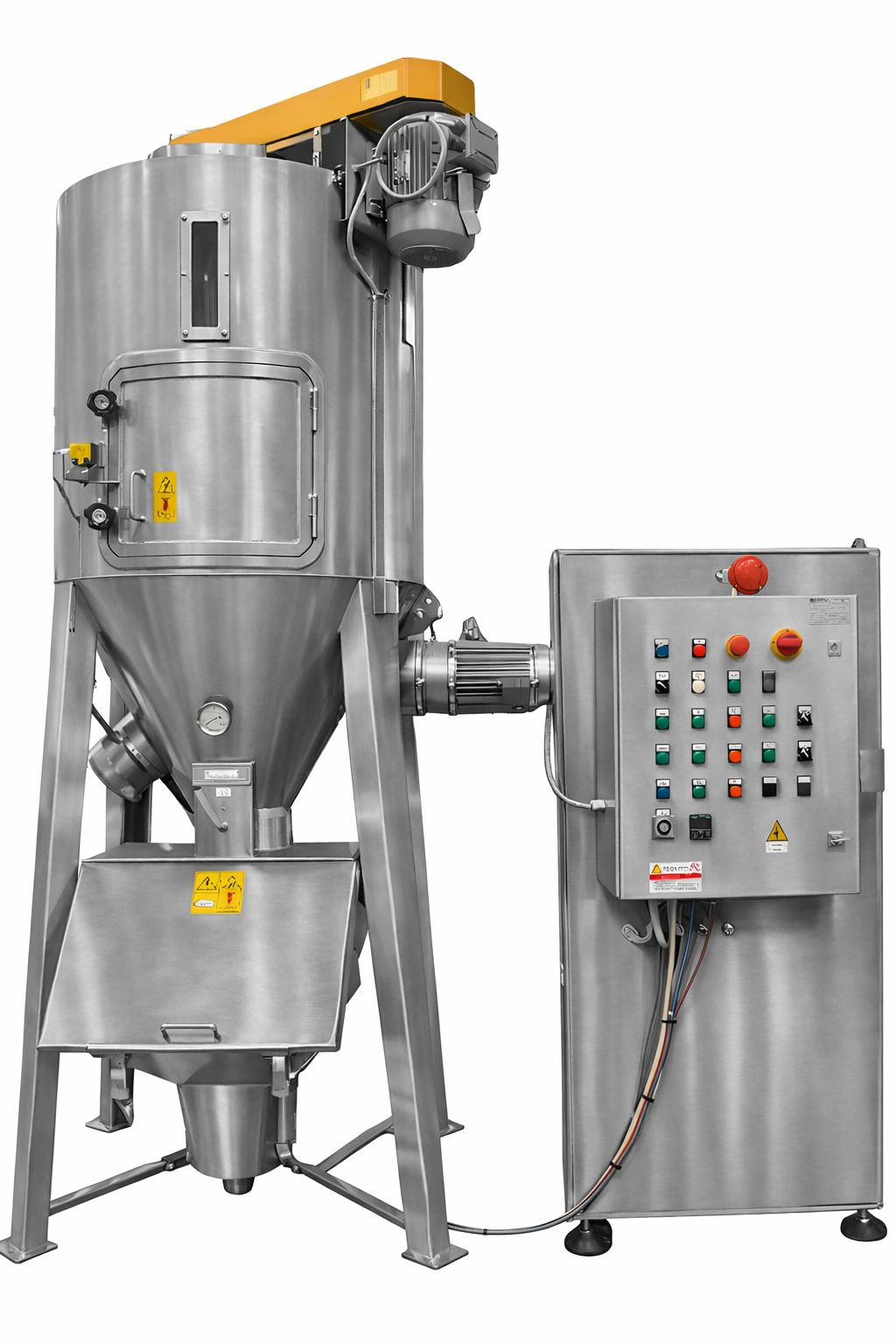
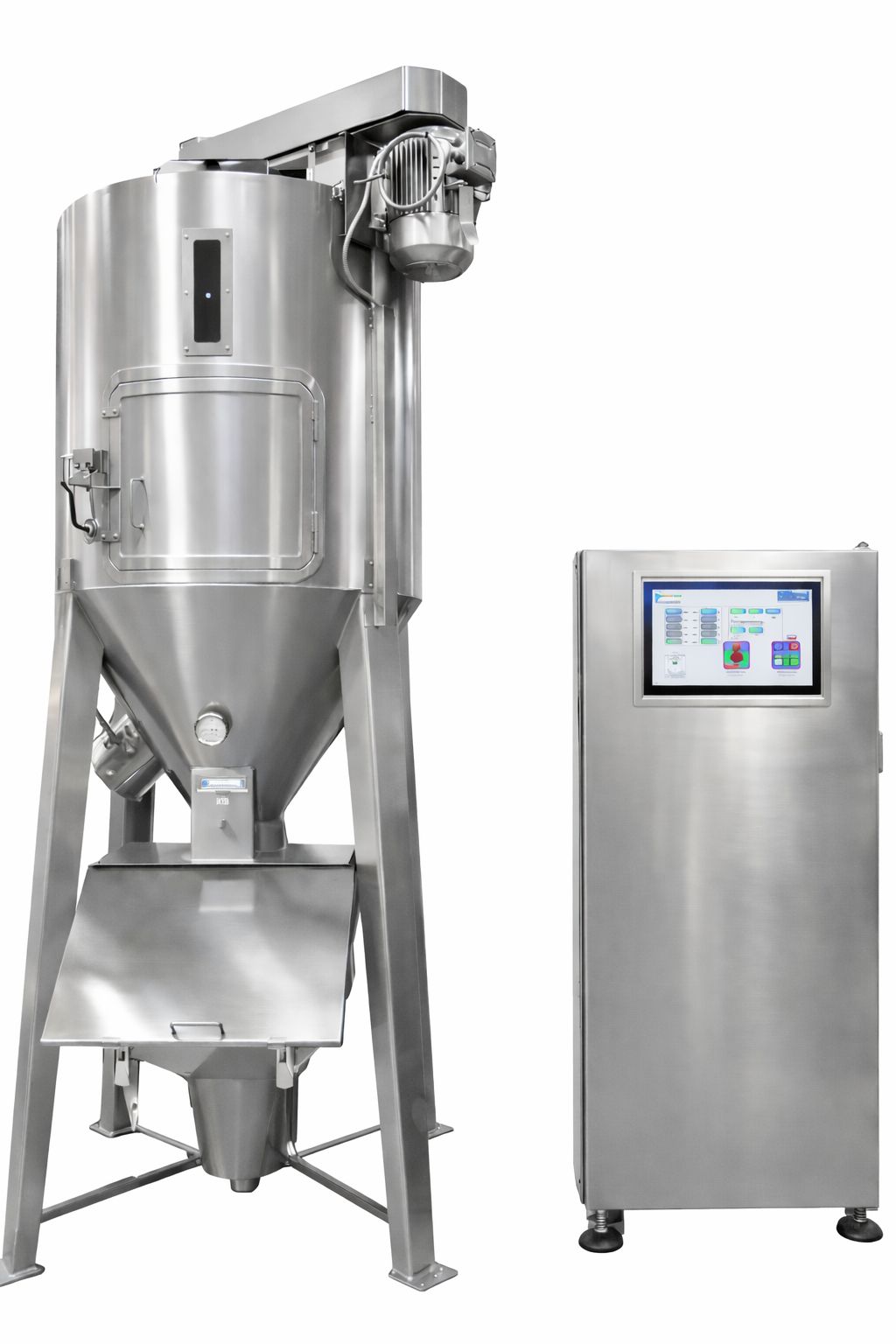
A typical hot air dryer consists of the following main components:
• Electric heating elements
• Radial or axial fan
• Thermostat or PID temperature control unit
• Insulated drying hopper
• Air distribution cone or perforated distributor
• Safety thermostat and overtemperature protection
The drying hopper is usually manufactured from stainless steel or aluminium. Insulation thickness typically ranges between 25 and 50 mm depending on the model. Insulation quality has a direct impact on energy consumption and temperature stability.
TECHNICAL AND NUMERICAL SPECIFICATIONS
Hot air dryers are manufactured in a wide range of capacities. Typical technical values are as follows:
Drying hopper volume
• 500 litres – 10,000 litres
Drying temperature range
• 40 °C – 140 °C
• Optional high-temperature versions: up to 180 °C
Heating power
• 4.5 kW – 45 kW
Fan airflow rate
• 40 m³/h – 2,000 m³/h
Electrical supply
• Small models: single-phase 230 V
• Medium and large models: three-phase 400 V
Energy consumption
• Average 0.06 – 0.15 kWh/kg, depending on material type and temperature
Typical drying times
• PP, PE: 1 – 2 hours at 80 – 100 °C
• ABS: 2 – 3 hours at 80 °C
• PS: 1.5 – 2 hours at 70 – 80 °C
These values may vary depending on ambient conditions and raw material characteristics.
ADVANTAGES OF HOT AIR DRYERS
Hot air dryers clearly demonstrate their advantages in many applications:
• Low initial investment cost
• Simple and robust mechanical design
• Easy installation and commissioning
• Very low maintenance requirements
• Simple operator training
• Low risk of failure
• Wide range of capacity options
These advantages make hot air dryers particularly attractive for cost-sensitive manufacturers.
LIMITATIONS AND TECHNICAL EVALUATION
Although hot air dryers offer economical and practical solutions, they also have certain technical limitations:
• Performance decreases in humid environments due to reliance on ambient air
• Very low moisture levels cannot be achieved for hygroscopic plastics
• Dew point of the drying air cannot be controlled
• Energy efficiency is lower compared to desiccant-based systems
For this reason, desiccant or compressed-air-based dryers are recommended for highly moisture-sensitive materials such as PA, PET, PC, and PBT.
APPLICATION AREAS
Hot air dryers are widely used in the following applications:
• Injection moulding machines
• Extrusion and profile lines
• Blow moulding machines
• Plastic recycling lines
• Pre-drying of masterbatch
• Low moisture-sensitive raw materials
They can be mounted directly on the processing machine or integrated into centralized drying systems.
HOT AIR DRYER SELECTION CRITERIA
To select the correct hot air dryer, the following technical criteria must be carefully evaluated:
• Hourly raw material consumption
• Type of material to be dried
• Required drying temperature
• Ambient temperature and humidity level
• Available energy infrastructure
• Space limitations
Selecting a system with the correct capacity and power based on these parameters directly affects both product quality and energy efficiency.